âââ€ã¢ââ€ã¢â†ââåroman Sarcophagiã¢ââ in a Companion to Roman Art Edited by Barbara E Borg
Mount Vesuvius buried Pompeii 2 millennia agone—creating a fourth dimension capsule of the development of Roman painting.

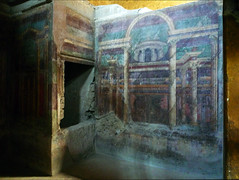
Example of a Fourth Way painting, before 79 C.E., fresco, Pompeii
Why Pompeii?
Paintings from antiquity rarely survive—paint, later on all, is a much less durable medium than stone or bronze sculpture. Only information technology is thanks to the ancient Roman metropolis of Pompeii that we can trace the history of Roman wall painting. The entire urban center was buried in volcanic ash in 79 C.E. when the volcano at Mountain Vesuvius erupted, thus preserving the rich colors in the paintings in the houses and monuments in that location for thousands of years until their rediscovery. These paintings represent an uninterrupted sequence of two centuries of evidence. And information technology is cheers to August Mau, a nineteenth-century German scholar, that we have a classification of iv styles of Pompeian wall painting.

View of Mount Vesuvius from Pompeii
The four styles that Mau observed in Pompeii were not unique to the city and can be observed elsewhere, like Rome and fifty-fifty in the provinces, but Pompeii and the surrounding cities cached past Vesuvius contain the largest continuous source of evidence for the flow. The Roman wall paintings in Pompeii that Mau categorized were true frescoes (or buon fresco), significant that pigment was practical to wet plaster, fixing the pigment to the wall. Despite this durable technique, painting is still a fragile medium and, once exposed to light and air, tin fade significantly, so the paintings discovered in Pompeii were a rare find indeed.
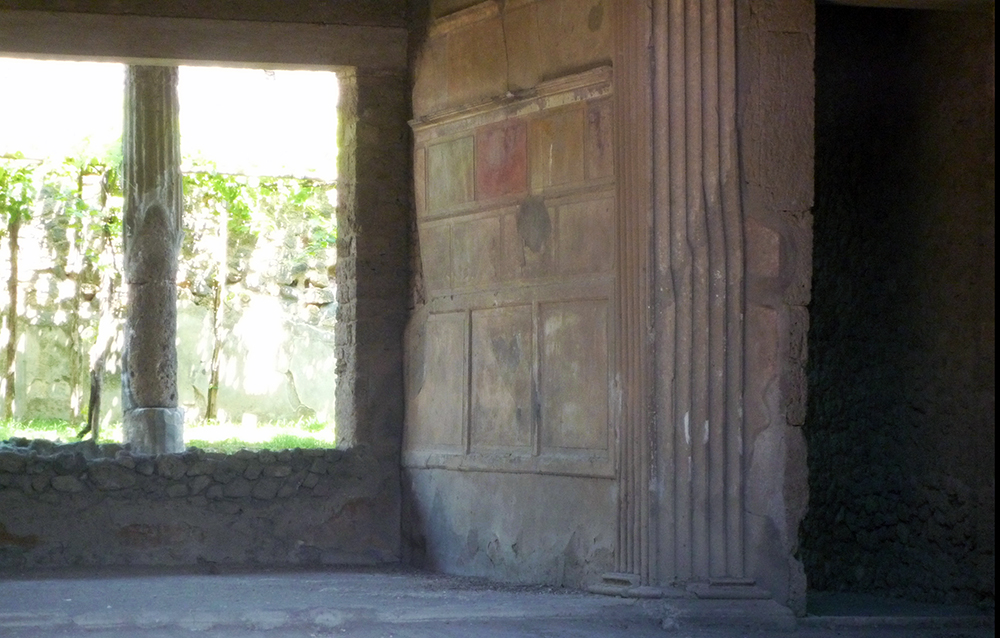
Example of First Style painting, House of Sallust, Pompeii, congenital 2d century, B.C.E.
In the paintings that survived in Pompeii, Mau saw four distinct styles. The start two were popular in the Republican period (which ended in 27 B.C.Eastward.) and grew out of Greek artistic trends (Rome had recently conquered Greece). The second two styles became fashionable in the Imperial period. His chronological description of stylistic progression has since been challenged by scholars, but they more often than not ostend the logic of Mau's approach, with some refinements and theoretical additions. Across tracking how the styles evolved out of 1 another, Mau's categorizations focused on how the creative person divided up the wall and used paint, color, image and form—either to comprehend or counteract—the flat surface of the wall.

Example of First Style painting, Business firm of the Faun, Pompeii, built 2d century, B.C.E. (photo: Steven Zucker, CC BY-NC-SA 2.0)
Kickoff Pompeian Style
Mau called the Commencement Manner the "Incrustation Style" and believed that its origins lay in the Hellenistic catamenia—in the 3rd century B.C.Eastward. in Alexandria. The First Manner is characterized past colorful, patchwork walls of brightly painted imitation-marble. Each rectangle of painted "marble" was connected by stucco moldings that added a 3-dimensional outcome. In temples and other official buildings, the Romans used costly imported marbles in a variety of colors to decorate the walls.

Detail of faux marble, Villa of the Mysteries, before 79 C.E., fresco, just outside the walls of Pompeii on the Road to Herculaneum (photo: Steven Zucker, CC BY-NC-SA 2.0)
Ordinary Romans could non afford such expense, so they decorated their homes with painted imitations of the luxurious yellow, royal and pink marbles. Painters became then skilled at imitating sure marbles that the big, rectangular slabs were rendered on the wall marbled and veined, just similar existent pieces of rock. Dandy examples of the First Pompeian Style can exist institute in the House of the Faun and the House of Sallust, both of which can still be visited in Pompeii.
Second Pompeian manner
The 2nd style, which Mau called the "Architectural Style," was kickoff seen in Pompeii around 80 B.C.E. (although information technology adult earlier in Rome) and was in vogue until the end of the start century B.C.E. The 2nd Pompeian Way adult out of the First Mode and incorporated elements of the Start, such as faux marble blocks along the base of walls.

Example of 2nd Mode painting, cubiculum (sleeping room), Villa of P. Fannius Synistor at Boscoreale, 50–40 B.C.East., fresco 265.4 x 334 10 583.nine cm (The Metropolitan Museum of Fine art)
While the Offset Manner embraced the flatness of the wall, the 2d Style attempted to trick the viewer into believing that they were looking through a window by painting illusionistic images. As Mau's proper name for the Second Style implies, architectural elements drive the paintings, creating fantastic images filled with columns, buildings and stoas.

Case of Second Style painting, cubiculum (chamber), Villa of P. Fannius Synistor at Boscoreale, 50–xl B.C.E., fresco (The Metropolitan Museum of Art)
In one of the near famous examples of the 2nd Way, P. Fannius Synistor's sleeping accommodation (now reconstructed in the Metropolitan Museum of Art), the creative person utilizes multiple vanishing points. This technique shifts the perspective throughout the room, from balconies to fountains and forth colonnades into the far distance, but the company'due south eye moves continuously throughout the room, barely able to register that he or she has remained contained within a small room.

Example of Second Fashion painting, view of the Dionysiac frieze, Villa of the Mysteries, earlier 79 C.E., fresco, 15 10 22 feet, just exterior the walls of Pompeii on the Road to Herculaneum (photo: Steven Zucker, CC BY-NC-SA 2.0)
The Dionysian paintings from Pompeii's Villa of the Mysteries are likewise included in the Second Style because of their illusionistic aspects. The figures are examples of megalographia, a Greek term referring to life-size paintings. The fact that the figures are the same size as viewers entering the room, too as the way the painted figures sit down in front of the columns dividing the space, are meant to suggest that the action taking place is surrounding the viewer.
Third Pompeian Manner
The Third Style, or Mau's "Ornate Fashion," came near in the early 1st century C.East. and was popular until about 50 C.Due east. The Third Style embraced the apartment surface of the wall through the utilize of broad, monochromatic planes of color, such as black or dark red, punctuated by minute, intricate details.

Example of Third Mode painting, panel with candelabrum, Villa Agrippa Postumus, Boscotrecase, last decade of the 1st century B.C.E. (The Metropolitan Museum of Art)
The Third Style was still architectural but rather than implementing plausible architectural elements that viewers would see in their everyday world (and that would function in an engineering sense), the Third Mode incorporated fantastic and stylized columns and pediments that could only exist in the imagined space of a painted wall. The Roman builder Vitruvius was certainly non a fan of Tertiary Style painting, and he criticized the paintings for representing monstrosities rather than real things, "for instance, reeds are put in the place of columns, fluted appendages with curly leaves and volutes, instead of pediments, candelabrum supporting representations of shrines, and on top of their pediments numerous tender stalks and volutes growing upwardly from the roots and having human figures senselessly seated upon them…" (Vitr.De curvation.VII.5.three) The center of walls often feature very small vignettes, such as sacro-idyllic landscapes, which are bucolic scenes of the countryside featuring livestock, shepherds, temples, shrines and rolling hills.

Instance of Third Style painting, panel with candelabra (particular with Egyptian motif ), Villa Agrippa Postumus, Boscotrecase, terminal decade of the 1st century B.C.E. (The Metropolitan Museum of Fine art)
The Third Way besides saw the introduction of Egyptian themes and imagery, including scenes of the Nile as well as Egyptian deities and motifs.
Fourth Pompeian Mode
The Fourth Style, what Mau calls the "Intricate Style," became pop in the mid-outset century C.E. and is seen in Pompeii until the metropolis'south devastation in 79 C.Eastward. It can exist best described as a combination of the three styles that came before. Faux marble blocks forth the base of the walls, as in the First Mode, frame the naturalistic architectural scenes from the Second Fashion, which in turn combine with the large apartment planes of color and slender architectural details from the Third Style. The 4th Style also incorporates central panel pictures, although on a much larger scale than in the third style and with a much wider range of themes, incorporating mythological, genre, landscape and however life images. In describing what we now call the 4th Style, Pliny the Elder said that it was adult by a rather eccentric, albeit talented, painter named Famulus who decorated Nero'due south famous Golden Palace. (Pl.NH XXXV.120) Some of the all-time examples of Fourth Mode painting come from the Firm of the Vettii which can also be visited in Pompeii today.
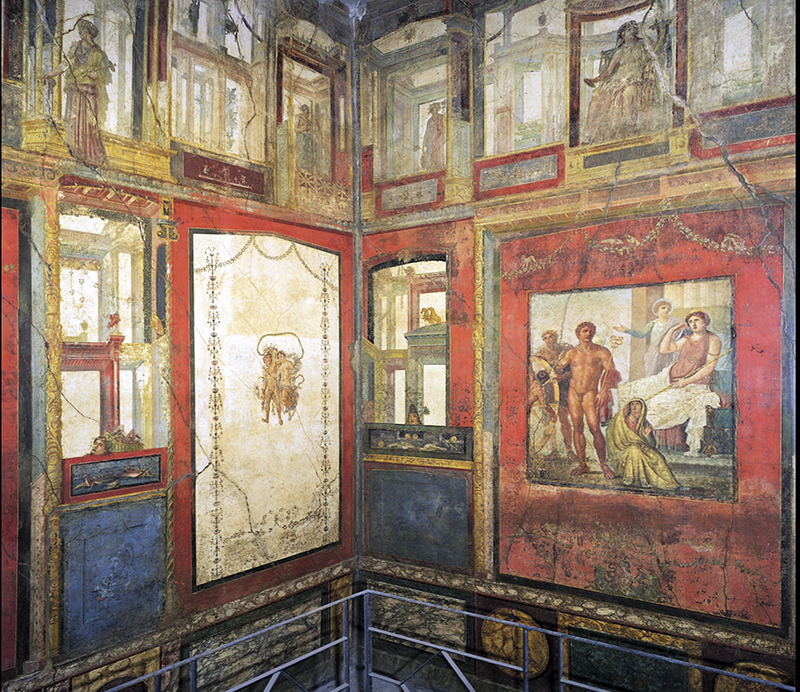
Example of Fourth Style painting, Ixion Room, House of the Vetii, Pompeii, 1st century C.Eastward.
Post-Pompeian painting: What happens next?
August Mau takes us every bit far as Pompeii and the paintings found at that place, but what nigh Roman painting after 79 C.E.? The Romans did keep to paint their homes and awe-inspiring architecture, but there isn't a Fifth or Sixth Way, and later Roman painting has been called a pastiche of what came before, just combining elements of earlier styles. The Christian catacombs provide an fantabulous tape of painting in Late Antiquity, combining Roman techniques and Christian subject thing in unique ways.
Additional Resources:
Roman Painting on the Heilbrunn Timeline of Fine art History
Joanne Berry,The Complete Pompeii(London: Thames & Hudson, 2013).
John R Clarke,The Houses of Roman Italian republic, 100 B.C.-A.D. 250: Ritual, Space, and Decoration. (Los Angeles: University of California Press, 1991).
Roger Ling. Roman Painting (New York: Cambridge Academy Printing, 1991).
August Mau. Pompeii: Its Life and Art. Translated by Francis Due west. Kelsey. (New York: The MacMillan Company, 1902). (Available on Kindle)
Smarthistory images for teaching and learning:



More than Smarthistory images…
Source: https://smarthistory.org/roman-wall-painting-styles/

Post a Comment for "âââ€ã¢ââ€ã¢â†ââåroman Sarcophagiã¢ââ in a Companion to Roman Art Edited by Barbara E Borg"