Oh Dionysus You Drank Yourself Under the Table Again
| The Frogs | |
|---|---|
 Greek actors Kostas Triantafyllopoulos every bit Xanthias (L) and Thymios Karakatsanis as Dionysus (R) in The Frogs in the Ancient Theatre of Epidaurus (1990) | |
| Written past | Aristophanes |
| Chorus | Frogs, Initiates, citizens of Hades |
| Characters | Dionysus Xanthias, Dionysus' slave Heracles corpse Charon Aeacus, janitor of Hades maid hostess Plathane, maid of the inn Euripides Aeschylus Pluto various extras |
| Setting | Outside Heracles' business firm; Lake Acheron; Hades |
The Frogs (Greek: Βάτραχοι , translit. Bátrakhoi , lit. "Frogs"; Latin: Ranae, often abbreviated Ran. or Ra.) is a comedy written by the Ancient Greek playwright Aristophanes. Information technology was performed at the Lenaia, one of the Festivals of Dionysus in Athens, in 405 BC and received starting time place.[1]
Plot [edit]

The Frogs tells the story of the god Dionysus, who, despairing of the state of Athens' tragedians, travels to Hades (the underworld) to bring the playwright Euripides back from the expressionless. (Euripides had died the year earlier, in 406 BC.) He brings along his slave Xanthias, who is smarter and braver than Dionysus. Equally the play opens, Xanthias and Dionysus argue over what kind of jokes Xanthias can use to open up the play. For the offset half of the play, Dionysus routinely makes critical errors, forcing Xanthias to improvise in lodge to protect his main and forbid Dionysus from looking incompetent—but this only allows Dionysus to go on to make mistakes with no event.
To observe a reliable path to Hades, Dionysus seeks communication from his half-brother Heracles, who had been there before in order to retrieve the hell hound Cerberus. Dionysus shows up at his doorstep dressed in a lion-hibernate and carrying a club. Heracles, upon seeing the effeminate Dionysus dressed up like himself, can't aid laughing. When Dionysus asks which route is the quickest to get to Hades, Heracles tells him that he can hang himself, drink poison or jump off a belfry. Dionysus opts for the longer journey, which Heracles himself had taken, beyond a lake (possibly Lake Acheron).
When Dionysus arrives at the lake, Charon ferries him across. Xanthias, being a slave, is not allowed in the boat, and has to walk around information technology, while Dionysus is fabricated to help row the boat.
This is the point of the first choral interlude (parodos), sung by the eponymous chorus of frogs (the simply scene in which frogs characteristic in the play). Their croaking refrain – Brekekekèx-koàx-koáx (Greek: Βρεκεκεκὲξ κοὰξ κοάξ ) – greatly annoys Dionysus, who engages in a mocking contend (agon) with the frogs. When he arrives at the shore, Dionysus meets up with Xanthias, who teases him by claiming to see the frightening monster Empusa. A second chorus composed of spirits of Dionysian Mystics soon announced.
The next see is with Aeacus, who mistakes Dionysus for Heracles due to his attire. Still aroused over Heracles' theft of Cerberus, Aeacus threatens to unleash several monsters on him in revenge. Frightened, Dionysus trades clothes with Xanthias. A maid then arrives and is happy to come across Heracles. She invites him to a banquet with virgin dancing girls, and Xanthias is more than happy to oblige. Only Dionysus speedily wants to trade back the clothes. Dionysus, back in the Heracles lion-peel, encounters more than people angry at Heracles, and so he makes Xanthias merchandise a third time.
When Aeacus returns to face up the declared Heracles (i.east., Xanthias), Xanthias offers him his "slave" (Dionysus) for torturing, to obtain the truth as to whether or non he is really a thief. The terrified Dionysus tells the truth that he is a god. Subsequently each is whipped, Dionysus is brought before Aeacus' masters, and the truth is verified. The maid and so catches Xanthias and chats him up, interrupted by preparations for the contest scene.
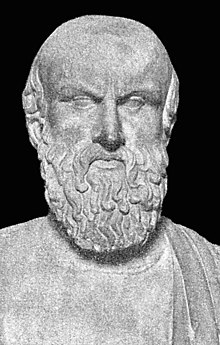
The maid describes the Euripides-Aeschylus disharmonize. Euripides, who had only only recently died, is challenging the slap-up Aeschylus for the seat of "Best Tragic Poet" at the dinner table of Pluto, the ruler of the underworld. A contest is held with Dionysus equally approximate. The ii playwrights take turns quoting verses from their plays and making fun of the other. Euripides argues the characters in his plays are ameliorate considering they are more true to life and logical, whereas Aeschylus believes his idealized characters are improve every bit they are heroic and models for virtue. Aeschylus mocks Euripides' poetry as anticipated and formulaic past having Euripides quote lines from many of his prologues, each time interrupting the declamation with the aforementioned phrase " ληκύθιον ἀπώλεσεν " ("... lost his little flask of oil"). (The passage has given rise to the term lekythion for this blazon of rhythmic group in poesy.) Euripides counters past demonstrating the alleged monotony of Aeschylus' choral songs, parodying excerpts from his works and having each citation end in the same refrain ἰὴ κόπον οὐ πελάθεις ἐπ᾽ ἀρωγάν; ("oh, what a stroke, won't you come up to the rescue?", from Aeschylus' lost play Myrmidons). Aeschylus retorts to this by mocking Euripides' choral meters and lyric monodies with castanets.
During the contest, Dionysus redeems himself for his earlier role as the barrel of every joke. He now rules the phase, adjudicating the contestants' squabbles fairly, breaking up their prolonged rants, and applying a deep understanding of Greek tragedy.
To end the debate, a residuum is brought in and each are told to tell a few lines into it. Whoever's lines have the most "weight" volition cause the balance to tip in their favor. Euripides produces verses of his that mention, in turn, the ship Argo, Persuasion and a mace. Aeschylus responds with the river Spercheios, Death and two crashed chariots and two dead charioteers. Since the latter verses refer to "heavier" objects, Aeschylus wins, but Dionysus is notwithstanding unable to decide whom he will revive. He finally decides to take the poet who gives the best advice nearly how to relieve the city. Euripides gives cleverly worded but essentially meaningless answers while Aeschylus provides more than practical advice, and Dionysus decides to take Aeschylus back instead of Euripides. Pluto allows Aeschylus to return to life so that Athens may be succoured in her hr of need and invites anybody to a round of cheerio drinks. Before leaving, Aeschylus proclaims that Sophocles should have his chair while he is gone, non Euripides.
Critical assay [edit]
The parodos contains a paradigmatic example of how in Greek civilisation obscenity could be included in celebrations related to the gods.[2]
Politics [edit]
Kenneth Dover claims that the underlying political theme of The Frogs is essentially "erstwhile means good, new means bad".[iii] He points to the parabasis for proof of this: "The antepirrhema of the parabasis (718–37) urges the citizen-body to turn down the leadership of those whom information technology now follows, upstarts of foreign parentage (730–2), and turn back to men of known integrity who were brought up in the fashion of noble and wealthy families" (Dover 33). Kleophon is mentioned in the ode of the parabasis (674–85), and is both "vilified as a foreigner" (680–two) and maligned at the end of the play (1504, 1532).
The Frogs deviates from the blueprint of political standpoint offered in Aristophanes' earlier works, such equally The Acharnians (425 BC), Peace (421 BC), and Lysistrata (411 BC), which have all been termed 'peace' plays. The Frogs is not oftentimes thus labeled, still – Dover points out that though Kleophon was adamantly opposed to whatever peace which did not come of victory, and the last lines of the play suggest Athens ought to expect for a less stubborn end to the war, Aeschylus' advice (1463–5) lays out a plan to win and non a proposition of capitulation. Also, The Frogs contains solid, serious messages which represent significant differences from full general critiques of policy and idealistic thoughts of adept peace terms. During the parabasis Aristophanes presents communication to give the rights of citizens back to people who had participated in the oligarchic revolution in 411 BC, arguing they were misled by Phrynichus' 'tricks' (literally 'wrestlings'). Phrynichus was a leader of the oligarchic revolution who was assassinated, to full general satisfaction, in 411. This proposal was simple enough to exist instated by a unmarried act of the associates, and was actually put into effect by Patrokleides' prescript later on the loss of the fleet at Aegospotami. The anonymous Life states that this advice was the basis of Aristophanes' receipt of the olive wreath, and the author of the aboriginal Hypothesis says adoration of the parabasis was the major factor that led to the play's second production.[three]

Marble bosom from the fourth century BC depicting Alcibiades, who is referenced throughout the play
J.T. Sheppard contends that the exiled general Alcibiades is a main focus of The Frogs. At the time the play was written and produced, Athens was in dire straits in the state of war with the Peloponnesian League, and the people, Sheppard claims, would logically have Alcibiades on their minds. Sheppard quotes a segment of text from near the commencement of the parabasis:
But recall these men as well, your own kinsmen, sire and son,
Who take oftimes fought beside yous, spilt their blood on many seas;
Grant for that one fault the pardon which they crave y'all on their knees.
You whom nature fabricated for wisdom, let your vengeance autumn to sleep;
Greet every bit kinsmen and Athenians, burghers true to win and keep,
Whosoe'er will brave the storms and fight for Athens at your side!—Murray translation, from l. 697
He states that though this text ostensibly refers to citizens dispossessed of their rights, it will actually evoke memories of Alcibiades, the Athenians' exiled hero. Farther support includes the presentation of the chorus, who recites these lines, equally initiates of the mysteries. This, Sheppard says, will as well prompt recollection of Alcibiades, whose initial exile was largely based on impiety regarding these religious institutions. Continuing this idea, the audience is provoked into remembering Alcibiades' return in 408 BC, when he made his peace with the goddesses. The reason Aristophanes hints and then subtly at these points, according to Sheppard, is because Alcibiades still had many rivals in Athens, such as Kleophon and Adeimantus, who are both blasted in the play. Sheppard also cites Aeschylus during the prologue debate, when the poet quotes from The Oresteia:
Subterranean Hermes, guardian of my father's realms,
Become my savior and my marry, in reply to my prayer.
For I am come up and do return to this my land.—Dillon translation, from fifty. 1127
This choice of extract again relates to Alcibiades, even so stirring his memory in the audience. Sheppard concludes past referencing the direct mention of Alcibiades' name, which occurs in the class of Dionysus' final test of the poets, seeking advice about Alcibiades himself and a strategy for victory. Though Euripides first blasts Alcibiades, Aeschylus responds with the advice to bring him dorsum, bringing the subtle allusions to a conspicuously stated head and concluding Aristophanes' bespeak.[4]
Structure [edit]
According to Kenneth Dover, the construction of The Frogs is every bit follows: In the first section Dionysus' has the goal of gaining admission to Pluto'due south palace, and he does so past line 673. The parabasis follows, (lines 674–737) and in the dialogue between the slaves a power struggle between Euripides and Aeschylus is revealed. Euripides is jealous of the other'southward identify equally the greatest tragic poet. Dionysus is asked by Pluto to mediate the contest or agon.[3]
Charles Paul Segal argues that The Frogs is unique in its structure, because it combines two forms of comic motifs, a journeying motif and a contest or agon motif, with each motif being given equal weight in the play.[5]
Segal contends that Aristophanes transformed the Greek comedy structure when he downgraded the contest or agon which unremarkably preceded the parabasis and expanded the parabasis into the agon. In Aristophanes' earlier plays, i.due east., The Acharnians and The Birds, the protagonist is victorious prior to the parabasis and after the parabasis is usually shown implementing his reforms. Segal suggests that this deviation gave a tone of seriousness to the play. For more than detail see Erstwhile Comedy.
Sophocles [edit]
Sophocles was a very influential and highly admired Athenian playwright who died after the play had already been written, during the first phase of its product. Aristophanes did not have enough fourth dimension to rewrite the play with Sophocles in it, then he simply added in scattered references to Sophocles'southward contempo death, referring to him as a worthy playwright.[6] When Aeschylus leaves the underworld at the cease of the play, Sophocles takes his throne.
References to the play [edit]

A 1902 playbill of The Frogs
In the Gilbert and Sullivan light opera The Pirates of Penzance, Major-General Stanley, in his introductory song, includes the fact that he "knows the croaking chorus from The Frogs of Aristophanes" in a list of all his scholarly achievements.
Stephen Sondheim and Burt Shevelove freely adapted The Frogs to a 1974 musical of the same name, replacing the Greek playwright characters with George Bernard Shaw and William Shakespeare.
Hope Mirrlees's Paris: A Poem (1920) cites the chorus in the opening of her modernist poem: "Brekekekek coax coax we are passing nether the Seine" (line 10), which also performs the sound of the metro train.[7]
Finnegans Wake references this play with the words "Brékkek Kékkek Kékkek Kékkek! Kóax Kóax Kóax! Ualu Ualu Ualu! Quaouauh!"[8]
The call of the Frog Chorus, "Brekekekéx-koáx-koáx" (Greek: Βρεκεκεκέξ κοάξ κοάξ), followed past a few of Charon's lines from the play, formed function of the Yale "Long Cheer", which was first used in public in 1884, and was a characteristic of Yale sporting events from that time until the 1960s.[9] [10] [eleven] Lake Forest Academy's teams are known every bit the "Caxys", a proper noun derived from a similar cheer.[12]
The Long Cheer was echoed in Yale graduate Cole Porter'south song "I, Jupiter" in his musical Out of This World, in which Jupiter sings "I, Jupiter Rex, am positively teeming with sexual practice," and is answered by the chorus "Brek-ek-ko-ex-ko-ex-Sex! Brek-ek-ko-ex-ko-ex-Sexual practice!"[10] Other colleges imitated or parodied the long cheer, including Penn, which adopted the cry, "Brackey Corax Corix, Roree".[9] Ane of these parodies was the first Stanford Axe yell in 1899, when yell leaders used it during the decapitation of a harbinger effigy: "Give 'em the axe, the axe, the axe!" The Frog Chorus besides figured in a later Axe Yell rendering the last 2 segments "croax croax", which was used by the Academy of California and Stanford University.
In his book Jesting Pilate, author Aldous Huxley describes listening to a performance of a poem on the subject area of Sicily by the Panjabi poet Iqbal, recited by a Mohammedan of Arab descent at a party in Bombay. Huxley summarized the performance with the statement: "And in the suspended notes, in the shakes and warblings over a unmarried long-drawn syllable, I seemed to recognize that distinguishing characteristic of the Euripidean chorus which Aristophanes derides and parodies in the Frogs".[13]
Translations [edit]
- Gilbert Murray, 1902, rhyming poetry, full text
- Matthew Dillon, 1995, full text
- George Theodoridis, 2008, prose, full text
- Ian C. Johnston, poesy, total text
- R. H. Webb, bachelor for digital loan
References [edit]
- ^ Aristophanes, Frogs. Kenneth Dover (ed.) (Oxford: Clarendon Press, 1993), p. two.
- ^ Amata, Biagio Cultura east lingue classiche 3, p79
- ^ a b c Dover, Kenneth (1997). Aristophanes' Frogs. New York: Clarendon Printing. ISBN0-nineteen-815071-seven.
- ^ Sheppard, J. T.; Verrall, A. West. (1910). "Politics in the Frogs of Aristophanes". Periodical of Hellenic Studies. The Society for the Promotion of Hellenic Studies. 30 (2): 249–259. doi:ten.2307/624304. JSTOR 624304.
- ^ Segal, Charles Paul (1961). "The Grapheme and Cults of Dionysus and the Unity of the Frogs". Harvard Studies in Classical Philology. Department of the Classics, Harvard University. 65: 207–242. doi:10.2307/310837. JSTOR 310837.
- ^ Roche, Paul (2005). Aristophanes: The Complete Plays: A New Translation by Paul Roche. New York: New American Library. pp. 537–540. ISBN978-0-451-21409-6.
- ^ "Paris by Hope Mirrlees".
- ^ Joyce, James (1939), Finnegans Wake , page iv, paragraph 1
- ^ a b Schiff, Judith Ann (1998), The Greatest Higher Cheer, Yale Alumni Magazine, retrieved 20 October 2016
- ^ a b Readers Think the Long Cheer, Yale Alumni Magazine, 2008, retrieved 11 December 2014
- ^ Branch, Marking Alden (2008), Greek Revival, Yale Alumni Magazine, retrieved eleven December 2014
- ^ "Educatee Life". Lake Forest Academy.
- ^ "Jesting Pilate" folio 24 paragraph 1, Paragon Firm, First Paperback Edition, 1991
Farther reading [edit]
- The Frogs in Greek (from Perseus Project)
External links [edit]
Source: https://en.wikipedia.org/wiki/The_Frogs

Post a Comment for "Oh Dionysus You Drank Yourself Under the Table Again"